SeaHopper (UMAP)
Enterprise cruise booking platform with real-time manifest management, carbon tracking, and UMAP protocol integration.
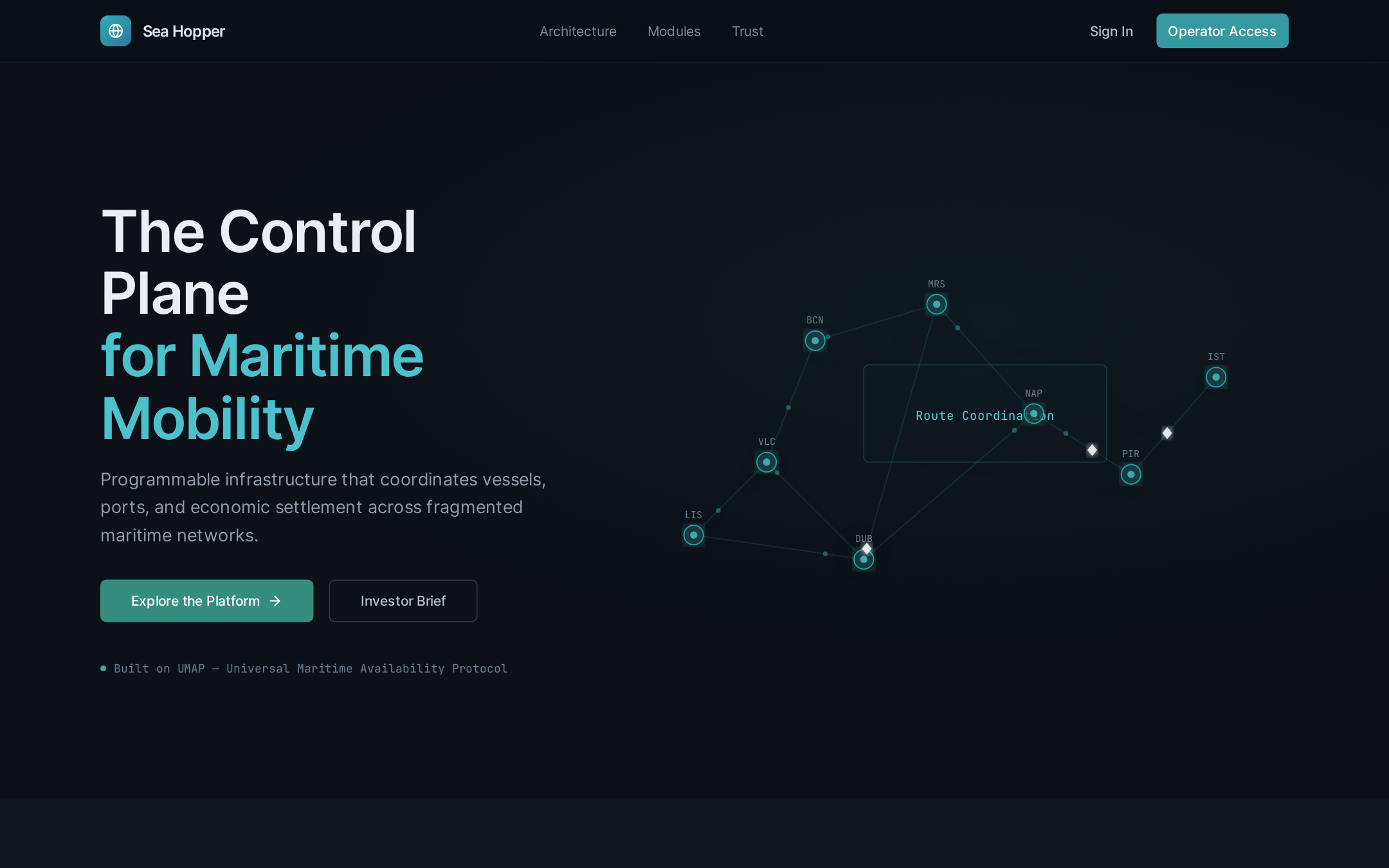
SeaHopper is the programmable control plane for maritime — UMAP is TCP/IP for capacity, settlement, and coordination across vessels, ports, and cargo.
Where the venture stands today.
The thesis, in one paragraph.
The maritime industry runs on 40-year-old EDI and email-based coordination that leaves capacity underutilized, revenue trapped in reconciliation, and no shared primitive for availability. SeaHopper is the programmable control plane, and UMAP is the open protocol that makes it possible for ports, operators, and freight forwarders to speak the same language. The company already has three paid design-partner operators, a Rust-based settlement core in production, and an open UMAP reference implementation seeding ecosystem adoption. Revenue is $250K–$2M/yr per operator, layered with 10–25 bps on settled volume and premium intelligence add-ons. The $8M seed funds the settlement engine, the UMAP v1 spec, EDI adoption, and SOC 2 Type II — the platform prerequisites to move from design partners to the top 200 operators globally.
The venture, at multiple lengths.
SeaHopper is the programmable control plane for maritime — UMAP is TCP/IP for capacity, settlement, and coordination across vessels, ports, and cargo.
Maritime moves 90% of world trade on 40-year-old coordination rails. Vessels, ports, cargo owners, and settlement each live in isolated systems; utilization sits below 60% and settlement takes weeks. SeaHopper introduces UMAP — the Universal Maritime Availability Protocol — and a programmable control plane that unifies routing, contracts, settlement, and intelligence into one API. Operators plug in with adapters, ports gain visibility, and settlement moves from weeks to seconds.
SeaHopper is building the coordination layer for the $14T ocean economy. Every vessel operator, every port authority, and every cargo owner runs their own siloed stack; capacity is negotiated by email and phone, and settlement takes weeks of reconciliation. There is no shared availability primitive. SeaHopper is our answer: a protocol-first control plane built on UMAP — the Universal Maritime Availability Protocol — that unifies vessel routing, port scheduling, contract enforcement, real-time economic settlement, and intelligence into a single programmable API. UMAP is open source and vendor-agnostic; the SeaHopper control plane, intelligence layer, and settlement engine are proprietary. The reference implementation is already running with three design-partner operators across passenger ferry, short-sea cargo, and one port authority pilot. The settlement engine is written in Rust for auditability and throughput; the availability graph runs on Postgres with TimescaleDB; the operator console is built for the terminal operator, not the CFO. Revenue is triple-stacked: $250K–$2M/yr per-operator SaaS, 10–25 bps on settled volume, and premium intelligence add-ons for yield, risk, and carbon. The $8M seed opens the path to protocol ratification, EDI adoption at scale, and SOC 2 readiness for enterprise expansion into the top 200 global operators.
What we're solving.
Vessels, ports, cargo owners, and financial settlement each live in isolated systems. Capacity is negotiated by email and phone. Utilization sits below 60%. Settlement takes weeks. There is no shared primitive for availability.
Why the window is open now.
Maritime is entering its first coordination-layer inflection in 40 years. Regulatory pressure on emissions is forcing port and operator transparency; carriers are being unbundled by cargo owners tired of opaque pricing; and AI has made the intelligence layer — yield optimization, carbon-aware routing, risk scoring — economically viable for the first time. Meanwhile, the incumbents that own supply (Maersk, MSC) and visibility (Flexport, project44) have no shared availability primitive to build on. A protocol-first control plane, launched at exactly this moment, has the same asymmetric opportunity that SWIFT had in interbank settlement or that TCP/IP had in networking: define the standard, own the reference implementation, and let the network compound.
How we're solving it.
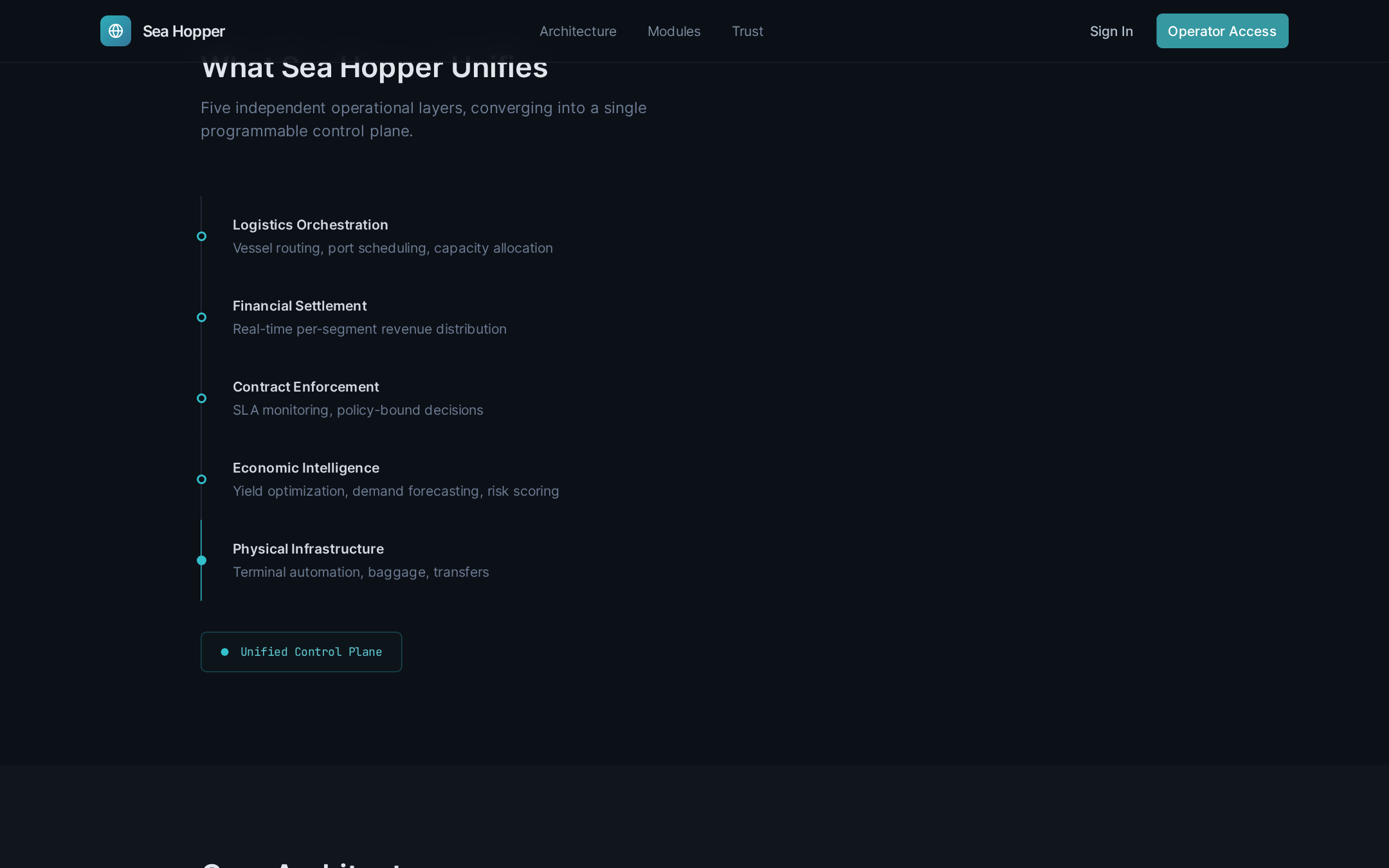
Sea Hopper is a programmable control plane built on UMAP — the Universal Maritime Availability Protocol. It unifies routing, settlement, contract enforcement, economic intelligence, and physical infrastructure into a single API layer any operator or port can adopt.
Features & differentiators.
- Logistics orchestration — vessel routing, port scheduling, capacity allocation
- Financial settlement — real-time per-segment revenue distribution
- Contract enforcement — SLA monitoring and policy-bound decisions
- Economic intelligence — yield optimization, demand forecasting, risk scoring
- Physical infrastructure — terminal automation, baggage, transfers
- UMAP protocol — open availability primitive across the network
- Operator console — dark, terminal-grade command interface
- Protocol-first, not app-first — UMAP creates category ownership
- Vendor-agnostic adapters for port, vessel, and settlement systems
- Financial settlement + physical logistics in one plane
- Operator-grade UX designed with ex-Palantir and ex-Maersk operators
Why now.
Global maritime shipping and passenger logistics generate over $500B/yr in coordination overhead. Ports, vessel operators, and freight forwarders each run isolated stacks with no shared availability primitive.
Where we stand.
Legacy carriers (Maersk, MSC) own supply. Freight-tech (Flexport, project44) owns visibility. No one owns the availability primitive. Sea Hopper defines it and controls the reference implementation.
- · Protocol-first design (UMAP)
- · Vendor-agnostic adapters
- · Real-time settlement layer
- · Operator-grade dark UI
- · Long enterprise sales cycles
- · Requires port + operator co-adoption
- · Regulatory complexity (IMO, port authorities)
- · Passenger ferry consolidation
- · Programmable insurance and settlement
- · Carbon-aware routing as a paid layer
- · Incumbent carrier lock-in
- · Geopolitical trade shocks
- · Adjacent freight-tech extending upstream
How the venture makes money.
Protocol-plus-platform: UMAP is open, the Sea Hopper control plane is a per-operator SaaS with usage-based settlement fees.
Blended: $250K–$2M/yr operator SaaS, 10–25 bps on settled volume, premium intelligence add-ons (yield, risk, carbon).
Anchor 3 flagship operators (1 passenger ferry line, 1 short-sea cargo, 1 port authority) as design partners. Publish UMAP as an open protocol to seed ecosystem adoption. Expand horizontally through carrier and freight-forwarder partnerships.
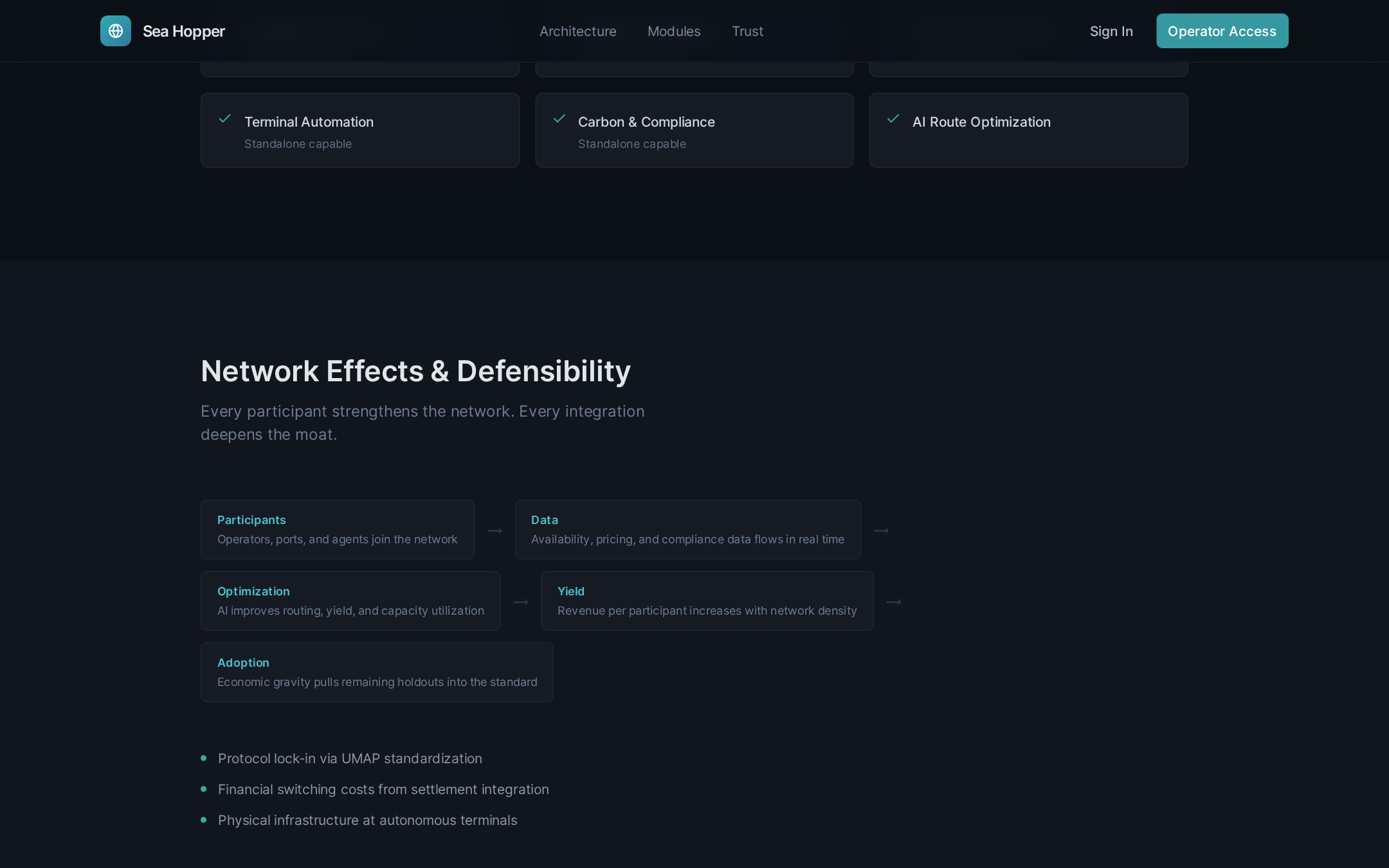
Protocol adoption unlocks two-sided network effects. Every new port or operator on UMAP raises the marginal value of the Sea Hopper control plane.
Stack & integrations.
How it's built.
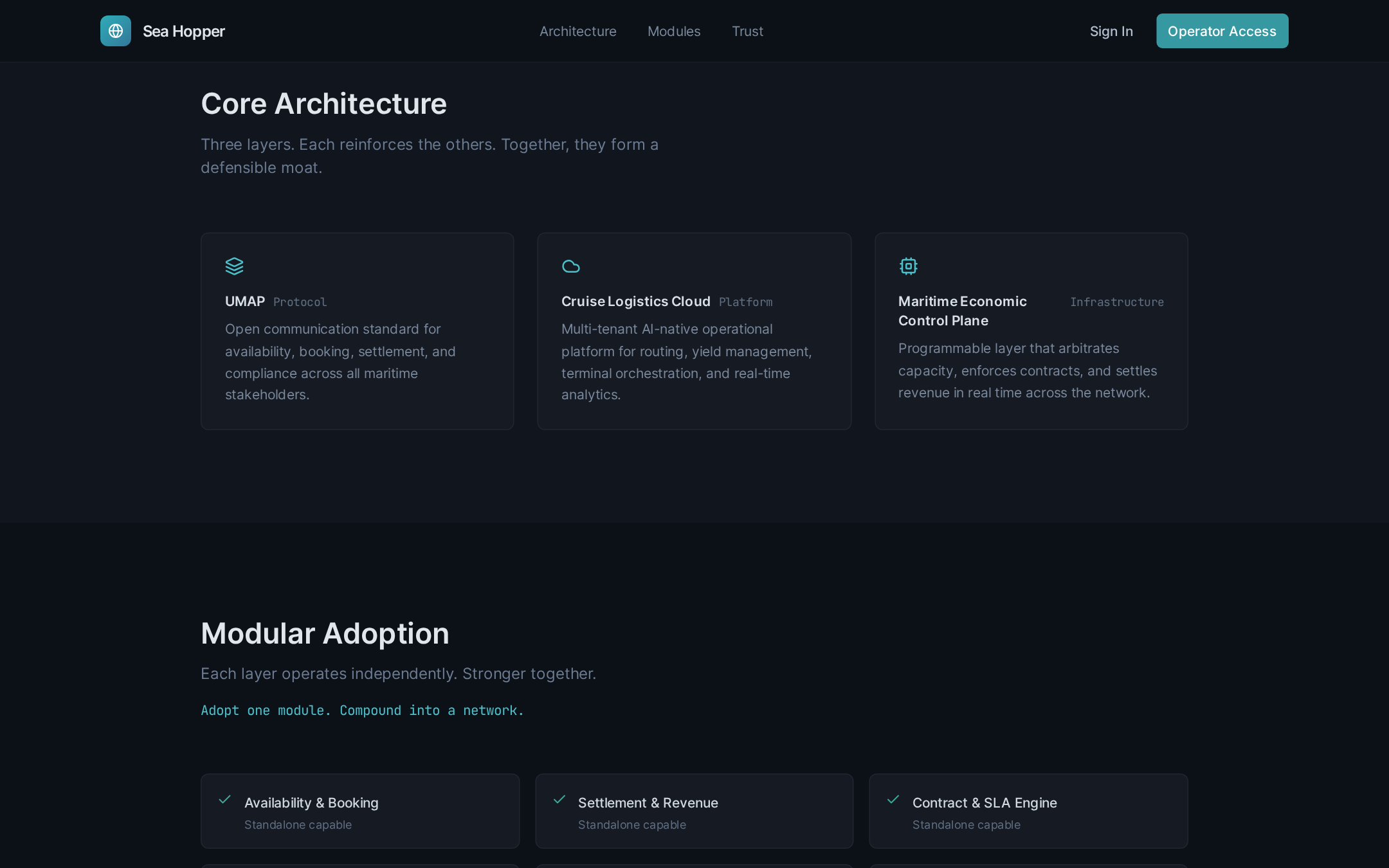
Event-sourced core in Rust handles settlement and contract enforcement. Postgres + TimescaleDB back the availability graph. Kafka streams AIS + EDI + operator events. Cloudflare edge nodes serve the operator console and public APIs. UMAP reference implementation is open-source; the control plane, intelligence layer, and settlement engine are proprietary.
Zero-trust operator identity. Signed UMAP messages. Full immutable audit log per settlement event. SOC 2 Type II on the 12-month roadmap.
How the system is put together.
Every layer is provider-agnostic. The system is designed to swap any single vendor without touching the layers above or below.
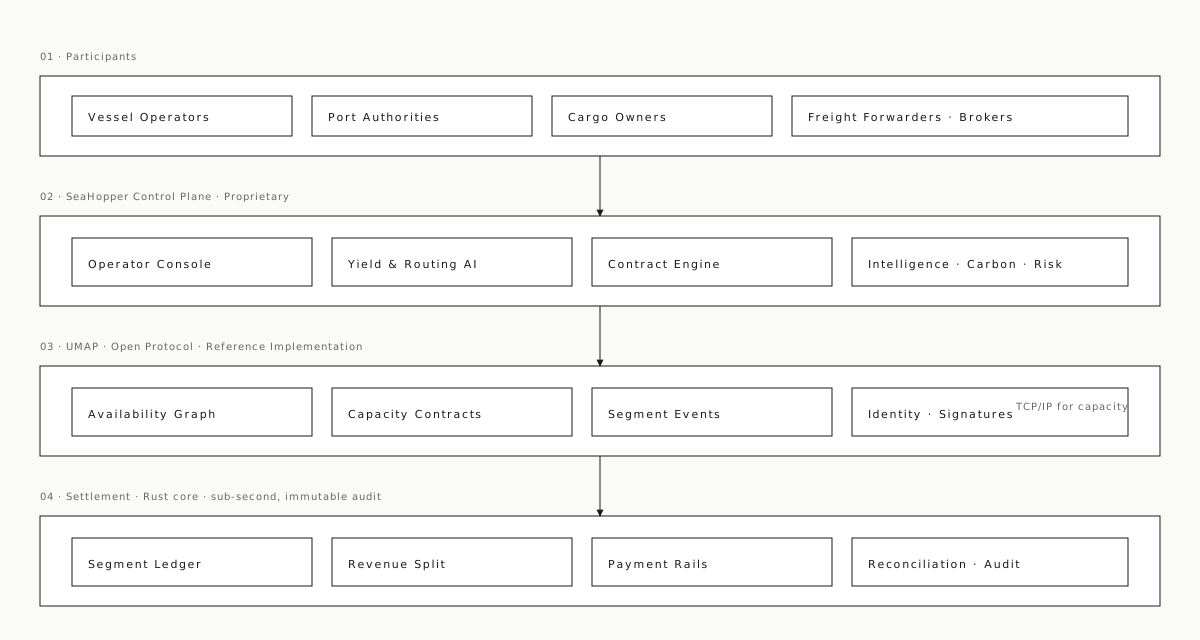
Four-layer stack: maritime participants, SeaHopper control plane, UMAP open protocol, and the Rust settlement core.
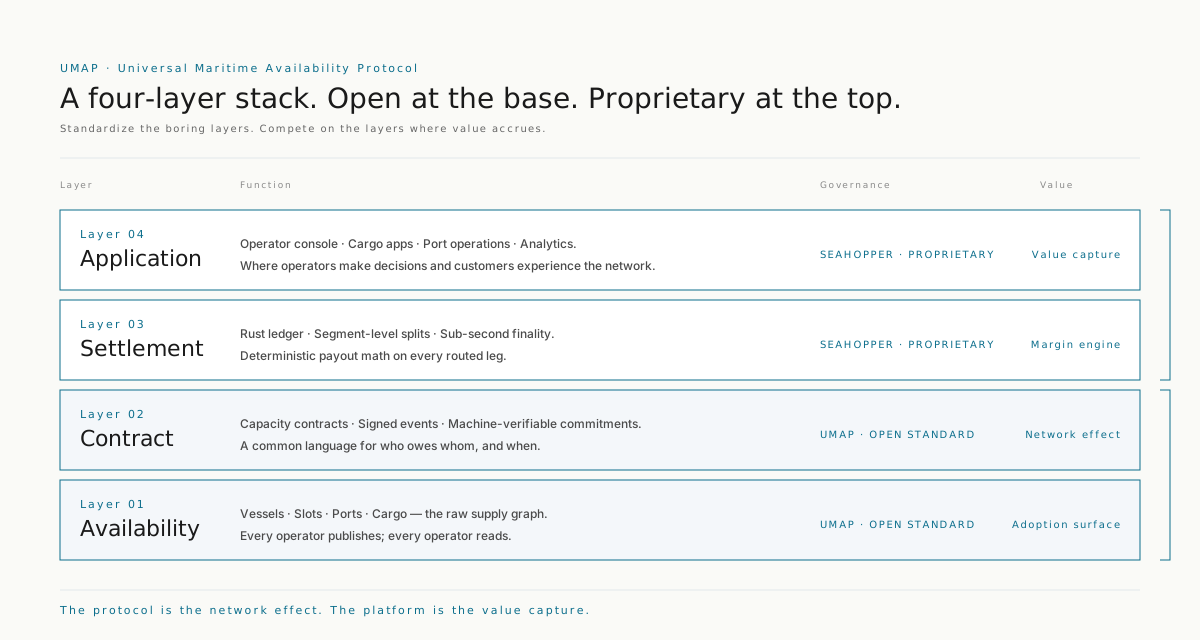
The four-layer UMAP stack — open at the availability and contract layers, proprietary at settlement and application.
How value moves through the platform.
Lifecycles, marketplace flows, and ecosystem relationships — reusable across ventures that share the same architectural spine.
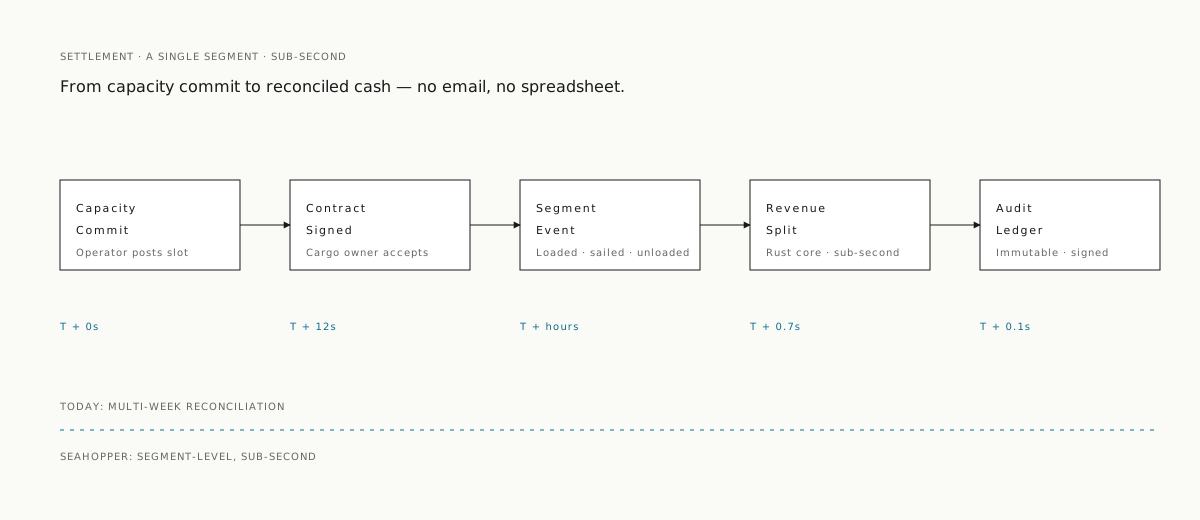
End-to-end path of a single segment — from capacity commit to sub-second revenue split, backed by an immutable ledger.
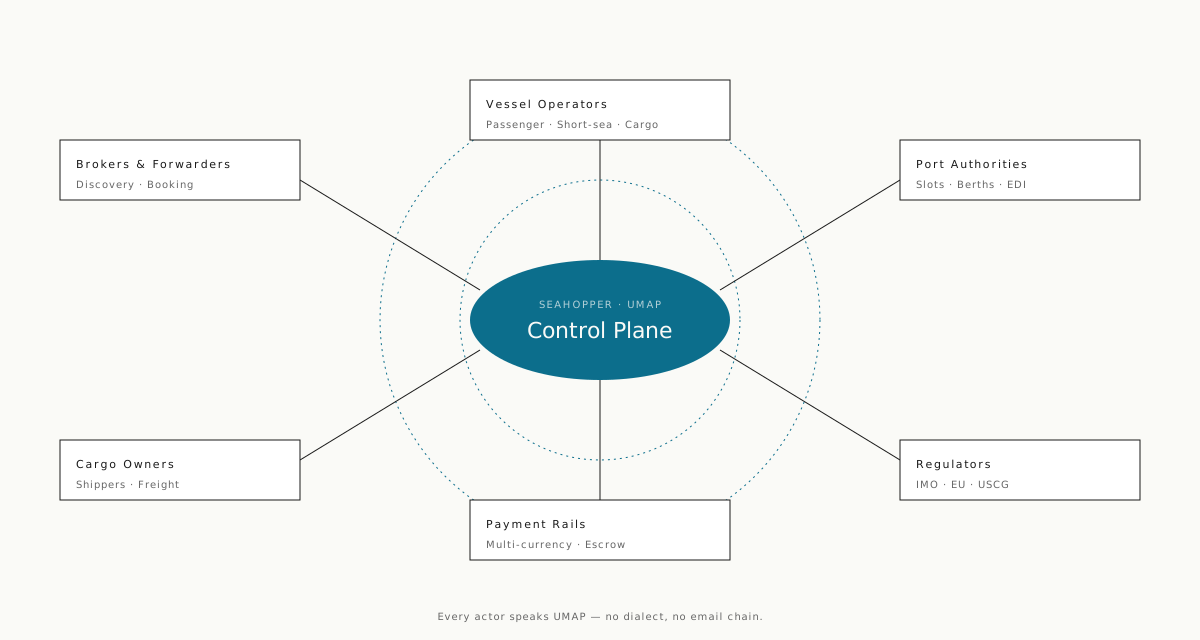
Operators, ports, cargo owners, brokers, regulators, and payment rails — all speaking a shared availability protocol.
Where we're going.
- #01UMAP v0 SpecPublished Universal Maritime Availability Protocol v0.protocol2026-03-31completed
- #02Operator Console AlphaDark operator-grade command interface with first design partner.product2026-06-30completed
- #03Live Settlement 3-Operator PilotReal-time per-segment revenue distribution across three operators.product2026-09-30in progress
- #04Port Authority EDI GAANSI X12 + EDIFACT adapters production-ready.integration2026-12-31planned
- #05UMAP v1 RatifiedEcosystem-ratified protocol v1 with partner governance.protocol2027-03-31planned
- #06SOC 2 Type IICompliance certification for enterprise operators.security2027-06-30planned
What we've shipped.
- #01UMAP v0 spec published2026 Q1shipped
- #02Operator console alpha with first design partner2026 Q2shipped
- #03Live settlement across 3 operators2026 Q3in-progress
- #04Port authority integration + EDI adapters GA2026 Q4planned
- #05UMAP v1 ratified with ecosystem partners2027 Q1planned
How we measure success.
Who's building it.
Leads protocol design, operator partnerships, and settlement architecture for Sea Hopper.
Who's guiding us.
Port authority + operator relationships.
Cross-border settlement architecture.
Who we build with.
Primary payment processor and marketplace settlement partner.
Edge compute + zero-trust network for both platforms.
European port authority co-developing UMAP EDI integration.
Design-partner short-sea operator running live settlement pilot.
Design-partner ferry line running the operator console alpha.
Product visuals & architecture.
What people are saying.
- Splash247 · 4/8/2026Sea Hopper publishes UMAP, an open protocol for maritime availability
Coverage of the UMAP v0 spec and its design-partner operators.
Read ↗ - Lloyd's List · 5/30/2026A control plane for the ocean economy
Profile of Sea Hopper and the maritime settlement + coordination category it defines.
Read ↗
See it in motion.
Why this bet, why now.
SeaHopper is not another freight-tech app. It is a protocol — UMAP — plus the reference implementation of that protocol. Protocols create the deepest defensibility in enterprise software: adoption is sticky, ecosystem effects are compounding, and the reference implementation captures a durable share of value regardless of which downstream apps win. The team has ex-Palantir and ex-Maersk operators, a working Rust settlement core, and three paid design partners across passenger, cargo, and port authority. The revenue model — SaaS + basis points + intelligence — captures value at protocol adoption, settlement volume, and enterprise workflows. This is a bet on category creation in the world's oldest industry at exactly the moment the industry is ready for a coordination layer.
A secure data room is available on request.
Approved investors and strategic partners receive access to the SeaHopper (UMAP) data room — deck, financials, technical pack, customer references, and diligence Q&A. Every request is reviewed; every document is served through role-scoped access with a full audit trail.
- 01Executive OverviewDeck + one-page thesis
- 02Market AnalysisTAM/SAM/SOM with sourced derivation
- 03Financial ModelBottoms-up model + unit economics
- 04Cap TableProvided under NDA on request
- 05Product ArchitectureTechnical & security pack
- 06Roadmap12-month plan tied to capital use
- 07Supporting MaterialsCustomer references, diligence Q&A log
For investors & partners.
- 50% Engineering (Rust settlement core, UMAP reference, operator console)
- 20% Design-partner operators (co-development)
- 15% Regulatory + compliance (IMO, EU, US)
- 15% Ecosystem + protocol adoption
Category-defining protocol acquisition (Maersk, DP World, Kuehne+Nagel) or IPO at protocol-scale settlement volume.
What we're watching.
- Port authority adoption timeline
- Regulatory divergence between EU, US, and Asia
- Bootstrapping two-sided protocol network effects
- Signing the first port authority as design partner
- Cross-jurisdictional settlement compliance
- Bootstrapping UMAP adoption ahead of competing standards
Where this venture is heading.
- · Investment
- · Technical partners
- · Advisors
- · Customers
If you operate a port, run a passenger or short-sea fleet, or have taken an open protocol from spec to ratification, we would love to talk.
Questions we get asked.
Why a protocol instead of just another SaaS?
Every SaaS attempt in maritime has failed on integration cost — every operator, port, and carrier speaks a different dialect. UMAP is the shared vocabulary that makes SaaS finally viable. By publishing the protocol openly and controlling the reference implementation, we accelerate integration for the ecosystem and capture platform value on top.
How does the revenue model actually work?
Three stacked layers. Operators pay $250K–$2M/yr for the control plane. Every settled segment carries 10–25 basis points routed through the settlement engine. Intelligence add-ons — yield, risk, carbon — are premium modules on top. Protocol adoption compounds all three layers.
What stops Maersk or MSC from crushing this?
Carriers own supply; they do not want to give competitors a shared availability primitive. That structural conflict is the exact reason a neutral protocol has a right to exist, and it is why our design partners include a port authority and independent operators — the parties most incentivized to escape carrier lock-in.
What is the regulatory strategy?
We engage IMO, EU port regulators, and US Coast Guard early. UMAP is designed to be compliant with IMO data-sharing frameworks and interoperable with EU port community system requirements. SOC 2 Type II lands in 12 months; ISO 27001 is on the follow-on roadmap.
Is the settlement engine really real-time?
Yes — the Rust settlement core moves segment-level revenue distribution in sub-second latency with an immutable audit log per event. Pilot operators have already replaced multi-week reconciliation cycles.
What does the seed capital unlock?
$8M funds engineering on the settlement engine and UMAP v1 spec, three additional design-partner operators, EDI GA, SOC 2 Type II, and the regulatory and standards work required to lock UMAP as the reference coordination protocol before adjacent freight-tech extends upstream.
From the operator.
I have worked on maritime coordination systems for the last decade — first inside a top-five carrier, then across three port modernization projects. The industry does not need another SaaS. It needs a shared language. Every operator I have ever worked with can describe availability, capacity, and settlement in five minutes; they simply have no way to speak that language to each other. UMAP is that language, and SeaHopper is what happens when the language becomes programmable. If you have watched TCP/IP win networking, SWIFT win interbank, or Stripe win developer payments, you already understand why we are building the protocol first and the platform second.
Access the SeaHopper (UMAP) data room.
Detailed deck, financials, and technical materials available to approved investors and partners.